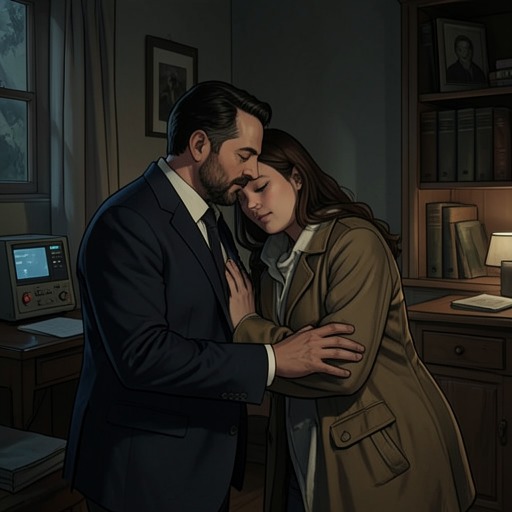
No hay marcha atrás en una historia de amor
También esto pasaráNo hay marcha atrás en una historia de amor is the principle Blanca draws from her relationship with Santi: love cannot be rewound to an earlier chapter, and returning to a relationship does not restore what it once was. Its companion formulation, a relationship is always a one-way road, turns that insight into an image of irreversible movement. The expression shapes the story’s view of reconciliation as an attempt made in the present, not a way back to the past.
Meaning and Formulation
Blanca states the expression while considering what happens when former partners resume their relationships. Its road image is deliberately absolute: a couple may turn toward one another again, but they cannot travel backward along the same route and recover an unchanged past. The phrase therefore distinguishes renewed contact from genuine restoration. What looks like a return is another stage in a relationship already altered by what has happened.
The line follows Blanca’s observation that many love affairs either last two months or last a lifetime. That sharp division leaves little room for a gradual, uncomplicated middle course. Her aphorism gives the uncertainty a shape: relationships may revive, but revival does not erase the direction or history that brought them to this point.
Santi’s Marriage and Blanca’s Hope
Santi’s circumstances give the expression its immediate force. After his wife began a love affair with one of his friends, that affair failed; Santi returned home, intending to comfort his wife and repair their marriage. By then, the relationship had replaced sex, curiosity, and admiration with comfort, companionship, and their children. His return is thus not a simple recovery of an intact marriage: the couple has arrived at a later condition, one shaped by the history between them.
At the same time, Blanca and Santi’s own story revives after it has begun to falter. Their relationship has been dying after a couple of months, but the impossibility and unreachability of the situation give it a renewed, almost mythical brightness. Blanca recognizes that both of them are taken in by this revival, though for different reasons. She has not found anyone she likes more; Santi recognizes that his marriage has resumed precisely where it stopped, at the last page before the book ended. The contrast makes the expression more than a comment on separation: neither relationship can simply begin again as if its intervening history had not occurred.
Love, Grief, and the Present
Elsewhere, Blanca describes sex as briefly displacing death and life alike. After sleeping with her former partner, Óscar, she wakes beside him and finds that the furniture, clothes, memories, panic, and grief have returned to their places. The temporary force of bodily intimacy offers no lasting reversal. This parallel sharpens the expression’s meaning: an intense return to the present can interrupt pain, but it cannot undo what has already happened.
Blanca’s grief also complicates any ideal of love as an unfailing refuge. When people remind her that many love her, she feels unable to take comfort in the reassurance; she remembers believing that even Blanca’s mother stopped loving her for a time. Against that uncertainty, the one-way-road expression does not promise that love will endure or that people can reliably restore what they have lost. It names the difficulty of going backward, whether the loss is a former state of a relationship or the security Blanca wishes love could provide.
Narrative Significance
The aphorism condenses a recurring tension in Blanca’s account: desire can briefly make life feel newly available, while memory and grief return with their full weight. Santi’s message that he wants to see her can pull her attention back toward her body and daily life, but it does not settle what their relationship can become. The phrase holds that gap open. It recognizes the power of renewed hope without mistaking hope for a restored past or a guaranteed future.